Rising damp guide
What Is a Bridged Damp-Proof Course?
A damp-proof course can be perfectly serviceable and still be ineffective if moisture has been given another route around it.
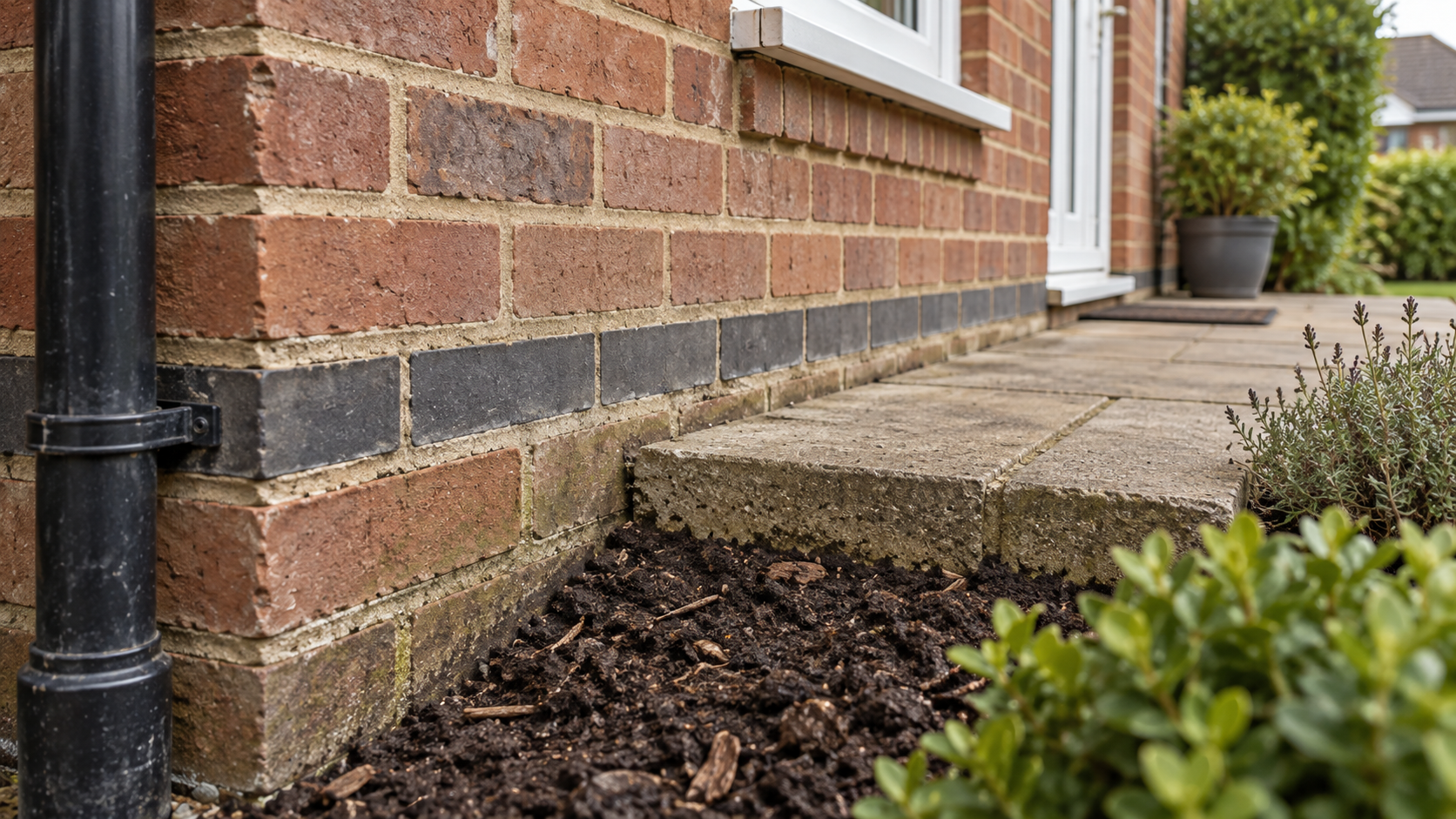
Raised paths and driveways
Successive resurfacing can gradually bring an outside path close to or above DPC level. Rain then wets masonry above the barrier. The practical question is not simply whether the DPC exists, but whether it still has clear separation from the ground.
Render crossing the DPC
External render taken down into the ground can form a moisture bridge. Removing or altering the lower section may be more relevant than injecting the masonry again.
Debris in cavity walls
Mortar droppings or rubble lodged at the bottom of a cavity can transfer moisture from the outer leaf to the inner wall. This cannot be diagnosed from the inside surface alone.
Do not lower ground blindly
Changing external levels can affect drainage and steps, doors or adjoining surfaces. The aim is to restore sensible DPC clearance and drainage, not simply excavate around the building without a plan.
Want somebody local to look at it?
If you would rather have the damp investigated in person, you can use our help page to describe the problem and decide what sort of specialist you need.